Through an immersive experience at the Rosebud Reservation, Clarkson College students gained a deeper understanding of culture, healthcare disparities, and the human side of patient care.
Some lessons simply can’t be taught in a classroom.
A group of Clarkson College students recently returned from a six-day trip, one they likely won’t ever forget.
Five undergraduate students, including four nursing students and one radiography student, embarked on a service trip to the Rosebud Reservation in southern South Dakota in mid-October. It was part of a new healthcare communication course offered at Clarkson College, called Immersive Journeys, focused on equipping students to care for and communicate with their patients in culturally appropriate ways.
“A key outcome of the immersion experience is that it allows students to apply the theory they are learning to better serve patients facing systemic issues that impact health outcomes,” says Danna Swartz, assistant professor with Clarkson College.
The five students, together with Swartz and Academic Travel and Mission Administrator Katie Steckman, accompanied by a Methodist School of Nursing student group, partnered with Sinte Gleska University nursing students and healthcare providers on the reservation. They spent their time:
- Administering flu shots and conducting health screenings as part of a mobile outreach.
- Shadowing healthcare providers in the one hospital on the reservation, including inpatient units, the Emergency Department, Dialysis and Radiology, and the outpatient clinic.
- Learning about the culture through the arts, games, and medicinal practices.
“The most meaningful experience for me was the connection with their nursing students,” says LaToya Thomas, Bachelor of Science in Nursing student with Clarkson College. “We were welcomed into their community in a way I will never forget.”
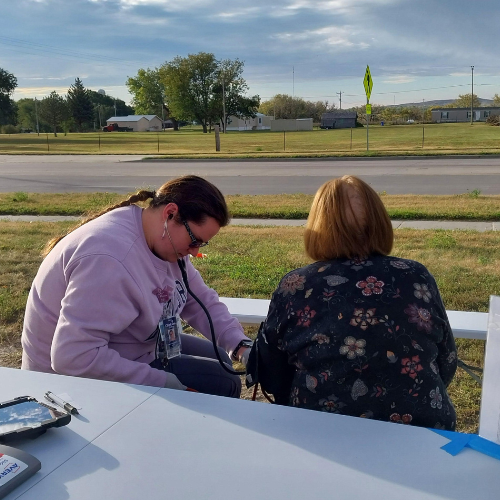
A student performs a health screening on a Rosebud resident.
A bleak environment
The circumstances facing the 26,000 Lakota on the Rosebud Reservation are challenging at best. The economic conditions are poor, with nearly half of the residents living below the federal poverty line and an unemployment rate estimated at 83%. When it comes to access to healthcare, residents can seek care at the Rosebud Indian Health System Hospital.
“Very few people have health insurance, so most are completely dependent on this one hospital,” explains Swartz. “Some residents live in the temporary trailers used during Hurricane Katrina.”
Access to healthy food is also scarce, and the reservation has few gas stations.
“We brought all our food,” says Swartz. The students stayed in a hotel about 45 minutes away.
“I've always had a passion for advocating for underserved communities, but this experience reminded me that everyone's struggles look different,” adds Thomas. “It made me reflect on my own biases, privileges, and how important it is to understand someone's circumstances before making judgments.”
A new class focused on intercultural communication
Swartz has been wanting to create this healthcare communications class for some time.
“It’s so important for students to understand that their normal is not their patient’s normal,” says Swartz.
The immersive student trip is a key component of the class. Ahead of the trip, students learned key cultural insights to prepare them to communicate within the Lakota culture, including body language, expressions, and tone.
“The Lakota people often don’t make eye contact the way a majority culture might expect,” says Swartz. “This is their way of showing you respect.”
Culture is especially important to understand when obtaining consent from a patient.
“You need to make sure people are consenting for the right reasons, not because they view you as an authority,” notes Swartz.
“As a nurse, I want to treat the whole person, not just their diagnosis,” says Thomas. “Healthcare isn't just about medications and treatments. It's also about understanding culture, access to resources, family dynamics, and the barriers people face every day. This experience strengthened my desire to advocate for those whose voices aren't always heard.”
“This trip opened my eyes to the challenges the Lakota people face and showed me how important it is to provide culturally competent and compassionate healthcare,” adds Brynn Tussey, Associate of Science in Radiography student with Clarkson College.
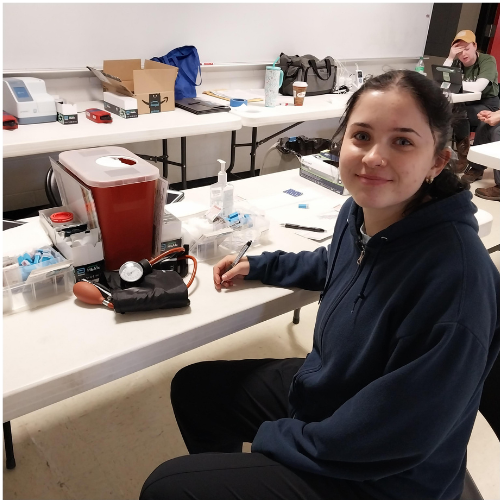
Student Audrey Leighow prepares for health screenings.
What’s ahead
Students are now reflecting on their immersive experience and, as part of their final assignment, they will take a trip to the Joslyn Art Museum to understand how Native Americans are portrayed in art and compare that to how Native Americans portray themselves. They also plan to host a Lunch-n-Learn with the College to share their learnings.
“The issues are so deep and complex at Rosebud, it’s really hard to cover that in a lecture,” says Swartz. “The students applied what they learned about healthcare communication theory in an immersive experience, which allows them to be better providers in the future.”

